




Your packaging is your automotive business’s foundation. It’s often an indicator of how well your parts will survive their trip to your customers and of how efficient your production line is. If you rely on off-the-shelf packaging for your automotive components, you risk damaging your brand and incurring prolonged, expensive production downtime. After all, a single damaged sensor or dented alternator is enough to halt an assembly line. In today’s expansive automotive industry, an hour of downtime can cost up to $2.3 million, or $600 per second — a substantial amount that could affect your bottom line.
Custom-molded fiber packaging reaches your customers in pristine condition while avoiding the risk of unexpected downtime. This guide outlines several reasons you should choose custom packaging for your automotive components and explains how to make it the foundation for your long-term success.
Why Standard Packaging Fails Automotive Engineers
Standard packaging and automotive components are naturally a mismatch because automotive components are rarely perfect squares. For instance, a headlight won’t fit perfectly into a standard box, leaving enough space for it to rattle. Void fill materials are the typical remedy for this issue. However, there is a hidden cost to using a combination of unreliable, generic solutions.
The Unforeseen Expenses of “Good-Enough” Protection
While standard packaging and generic materials like foam packing peanuts offer adequate protection, they often come with concealed operational costs.
- Micro-abrasion: Products that move around during shipping can develop flaws that lead to immediate rejections by OEMs.
- In-transit settling: Generic fill materials like foam peanuts shift and compress during transit, creating new spaces that allow parts to rattle and bounce in.
- Excessive labor time: Employees must manually fit parts into boxes and fill voids, slowing your line during high-volume production.
- Increased dimensional weight: Standard packaging requires a few extra inches on all sides for void fillers, requiring you to pay more to ship empty air.
- Repackaging and returns: If shipping damages the goods, the administrative expenses of processing a warranty claim are often higher than the cost of the packaging.
Custom-Molded Fiber — Precision Engineering for Complex Parts
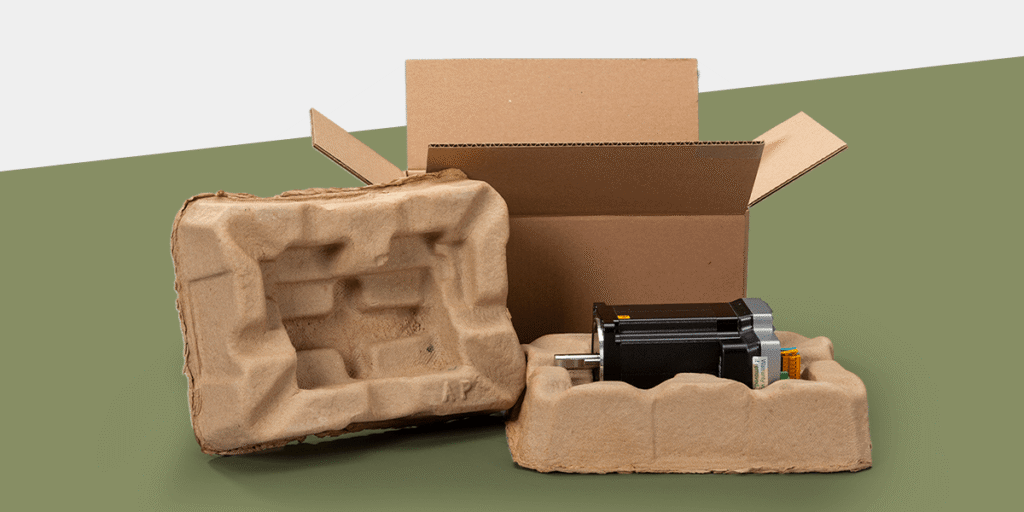
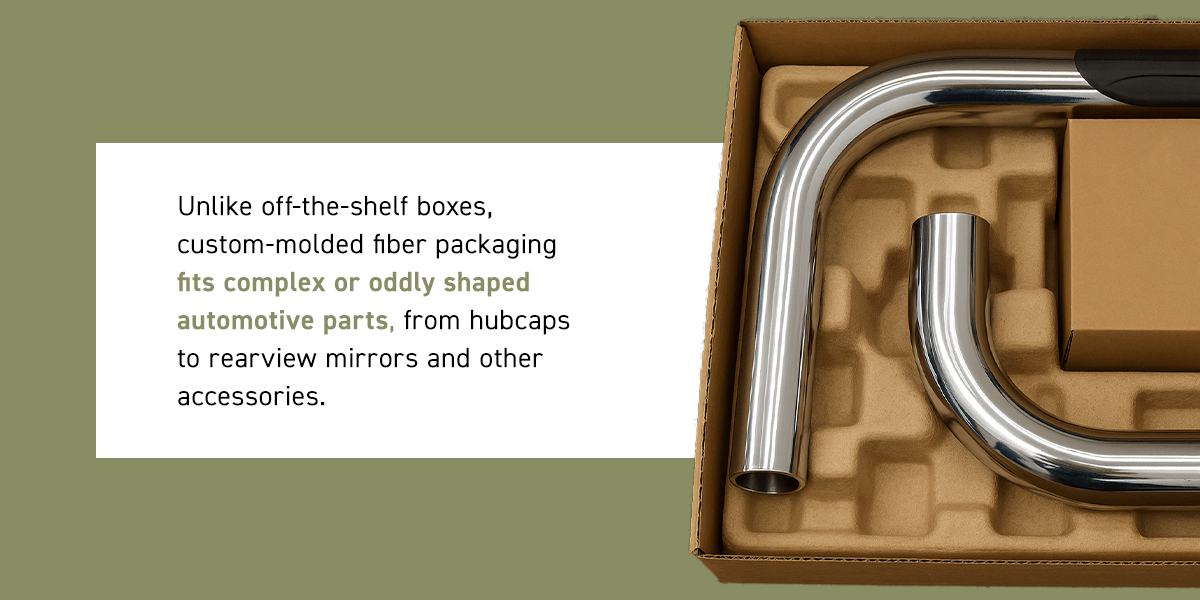
Unlike off-the-shelf boxes, custom-molded fiber packaging fits complex or oddly shaped automotive parts, from hubcaps to rearview mirrors and other accessories. Thanks to scrupulous engineering, these molded pulp boxes give you the peace of mind that your components will lock in place during shipping without the need for tape or wrap.
Custom packaging also eliminates the need for generic void fillers and corrugated die cuts, greatly minimizing the risk of micro-abrasions to your products in transit. The safety net it provides is especially crucial for heavy and fragile parts like rotors and glass.
Vibration Dispersion vs. Shock Compression
Shipping is the most volatile part of the manufacturing process because it exposes your parts to uncontrollable factors such as vibrations, shock and compression. Foam void fill can compress under repeated impacts, potentially transferring the shock to your parts.
In contrast, molded fiber’s structural integrity disperses in-transit vibration energy across the entire tray instead of focusing it on the item. Along with its ability to stay in place during a bumpy ride, this benefit makes molded fiber an excellent choice if item safety is your top manufacturing concern.
Great Northern Fiber Interior Packaging takes quality and durability seriously. Our ISTA-certified laboratory can conduct extensive stress testing on your packaging to ensure it withstands real-world shipping conditions without a scratch.
Labor Efficiency and Cube Density
At first glance, generic materials are a more economical choice than molded fiber. However, if you add up all the related costs, you’ll see that custom packaging offers an excellent financial advantage thanks to its drop-and-go mechanism and smaller footprint.
The “Drop-and-Go” Packing Advantage
Molded fiber can significantly reduce labor costs while increasing throughput speed due to its drop-and-go nature. With standard boxes, your employees need to cut a piece of bubble wrap to fit around each part, tape it to the box, fill voids with foam peanuts and finally secure it shut.
With molded fiber, the process is just three steps — place the part in the tray, stack the tray and close it. This effortless drop-and-go process requires considerably less labor, allowing your employees to pack more products in the same amount of time.
Optimizing Cube Density for Lower Freight Costs
Custom-molded fiber packaging reduces freight costs thanks to its smaller, lighter footprint. You can pack items tightly without adding void fill materials or paying extra to ship empty air. You can also fit more parts per pallet, reducing shipping expenses.
Sustainability Without Compromise
When you choose Fiber Interior Packaging’s custom packages, you help us drive sustainable packaging solutions. Our molded pulp inserts are 100% recyclable and biodegradable, making them the perfect solution for environmentally conscious companies.
Switch to Engineered Protection With Fiber Interior Packaging
Custom packaging for automotive components offers high structural integrity, precision-engineered fit and sustainable materials. Partner with Fiber Interior Packaging to equip your supply chain with 100% recyclable, custom-molded fiber packaging specifically designed for your complex parts. You also benefit from lower labor costs and increased production speed with our packaging’s drop-and-go design.
Get started by reviewing our FAQs to learn more about our industry-spanning packaging solutions. When you’re ready to make the switch, contact one of our specialists today.